Bubble
Quick Definition
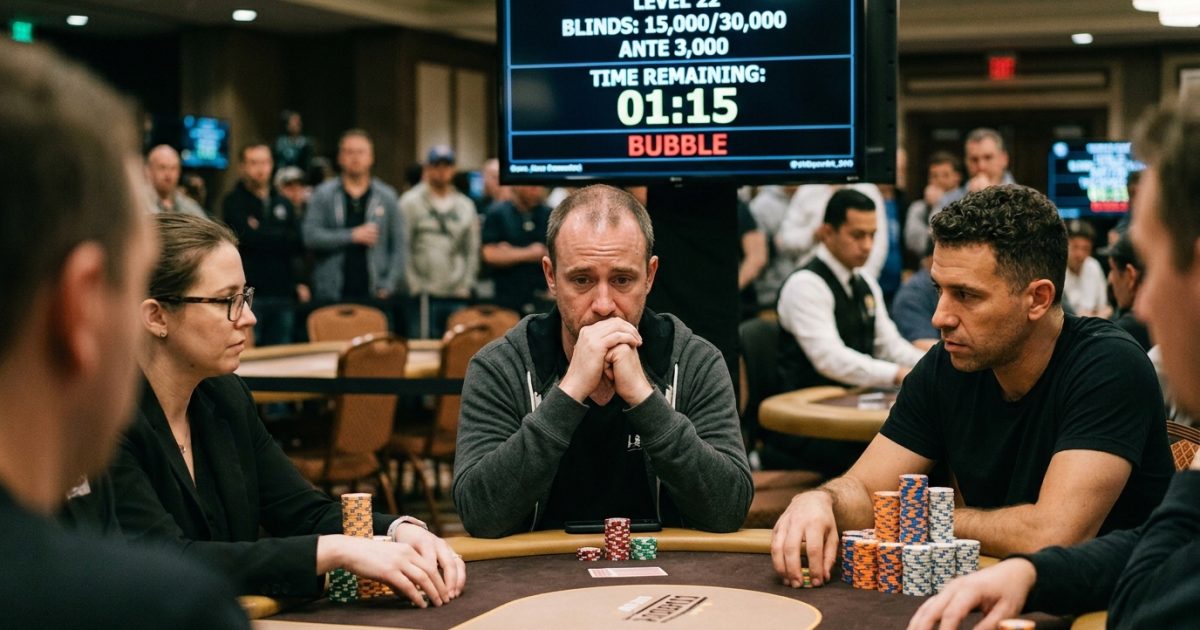
The bubble is the phase in a poker tournament when one more elimination separates the remaining players from reaching the paid positions, creating maximum pressure on short-stacked players who risk going home with nothing.
What Is the Bubble?
The bubble is the most psychologically intense moment in tournament poker. It is the point where one player stands between the entire remaining field and guaranteed prize money. If 1,000 players entered a tournament that pays 150 spots, the bubble occurs when 151 players remain. The next player eliminated receives nothing — the 150 surviving players all lock up at least a minimum cash.
This dynamic creates a unique strategic environment unlike any other phase of the tournament. Players with short stacks tighten up dramatically, desperate to survive into the money. Players with large stacks exploit this fear by ramping up aggression, stealing blinds and antes with impunity because shorter stacks cannot afford to play back without risking elimination.
The bubble is where understanding ICM (Independent Chip Model) transforms from theoretical knowledge into practical profit. Every chip risked on the bubble carries enormous equity implications. Busting on the bubble means earning zero after hours of play, while surviving guarantees a return on your investment. This asymmetry between risk and reward fundamentally changes which hands are playable and which should be folded.
How It Works
Bubble Identification: The bubble begins when the number of remaining players approaches the payout threshold. In online tournaments, the lobby displays how many players remain and how many will be paid. The “bubble zone” effectively starts when the remaining field is within 10% to 20% of the payout spots.
Hand-for-Hand Play: Once the bubble is imminent, most tournaments switch to hand-for-hand play. All tables must complete their current hand before the next hand is dealt simultaneously across the field. This prevents slow-play tactics where players stall to let other tables eliminate players first.
Big Stack Advantage: Players with large chip stacks hold enormous leverage on the bubble. They can raise liberally because short stacks cannot call without risking elimination. A big stack might raise 80% or more of hands on the bubble, profitably exploiting the tight play forced upon smaller stacks.
Short Stack Dilemma: Short stacks face agonizing decisions. Folding preserves your chance to cash but costs blinds and antes that erode your stack further. Shoving gives you a chance to double up but risks total elimination one spot from the money. The correct play depends on stack depth, payout structure, and the stacks of your specific opponents.
Money Bubble vs. Final Table Bubble: The money bubble gets the most attention, but similar dynamics occur at every significant pay jump — especially at the final table bubble. Bubbling the final table (finishing 10th in a 9-player final table) often means missing out on a substantial payout increase.
Example
You are playing a $200 tournament with 800 entries. The top 120 players are paid, with a minimum cash of $320. With 121 players remaining, you are on the exact bubble. You have 45,000 chips with blinds at 1,500/3,000 and a 400 ante — a stack of 15 big blinds. The chip leader at your table has 280,000 chips and has been raising every hand. They raise again to 7,500. You look down at Ace-Queen suited in the big blind. In a cash game, this is a clear all-in. On the bubble, you must consider: shoving and losing means you earn $0 after six hours of play. Folding and surviving two more eliminations guarantees at least $320. The ICM-correct play depends on the exact stack distribution at all remaining tables, but many professionals would fold this hand on the stone bubble despite its strength.
Where Bubble Play Matters Most
Bubble dynamics exist in every tournament format, but their impact varies by room and tournament type.
- GGPoker features large-field tournaments where the bubble can last 30 minutes or more in hand-for-hand play. Their massive guaranteed events create significant bubble pressure with hundreds of players on the edge.
- PokerStars has the largest tournament fields in online poker, meaning bubbles are longer and the strategic implications are more complex with thousands of players involved.
- 888poker runs tournaments with varying payout structures — flatter structures reduce bubble pressure, while top-heavy structures intensify it.
Related Terms
- ICM — the mathematical model that quantifies bubble decisions
- Multi-Table Tournament — the format where the bubble is most significant
- Final Table — the next major pressure point after the money bubble
- Satellite — a format with extreme bubble dynamics since all surviving players win identical prizes
FAQ
Is it ever correct to intentionally bust on the bubble?
Rarely, but yes. If you have an extremely short stack that will be blinded out before reaching the money, taking a gamble with any reasonable hand is better than folding into guaranteed elimination. The key is whether you have enough chips to realistically survive to the money through folding.
What is “bubbling” a tournament?
Bubbling means being the last player eliminated before the money. It is one of the most frustrating experiences in poker — investing hours into a tournament and leaving with nothing while every remaining player is guaranteed a payout.
How should I adjust my strategy on the bubble?
With a big stack, increase your aggression dramatically — raise wide, attack medium stacks who cannot afford to play back, and put maximum pressure on the table. With a medium stack, tighten up and avoid confrontations with bigger stacks. With a short stack, look for spots to shove when folded to you, especially against players who are also short and will be reluctant to call.