Full House
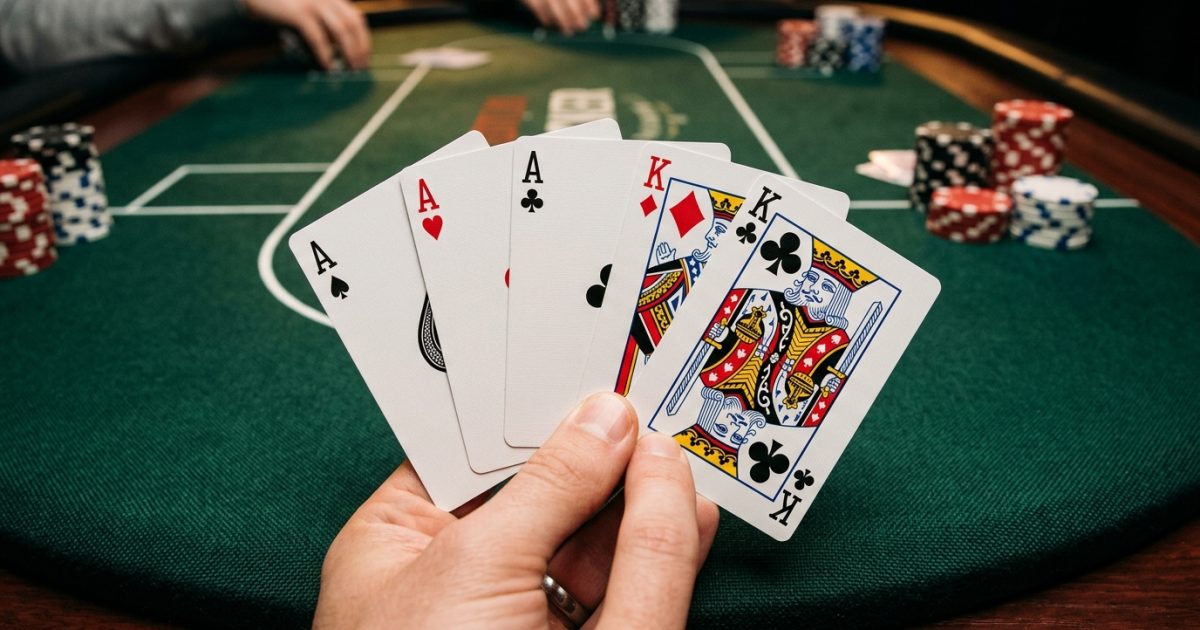
Quick Definition
A full house is a poker hand consisting of three of a kind plus a pair, ranking as the fourth-strongest hand in standard poker behind straight flush, four of a kind, and royal flush.
What Is Full House?
A full house, also commonly called a “boat” or “full boat,” is one of the most powerful hands in poker. It combines three cards of one rank with two cards of another rank — for example, three Kings and two Fives (called “Kings full of Fives”). In the hand rankings, it sits just below four of a kind and above a flush.
Full houses are strong enough to win the vast majority of pots they contest. Unlike flushes and straights, which are visible on the board and easy for opponents to identify, full houses can be well-disguised. A player holding a pocket pair who flops a set and then watches the board pair has a full house that opponents may not see coming. This hidden strength makes full houses among the most profitable hands in poker.
The frequency of full houses strikes a balance between rare enough to be powerful and common enough to be strategically relevant. You will make a full house approximately once every 37 to 38 hands in Hold’em (counting all seven available cards), which means you will see them regularly over a session. Learning to play them correctly — both when you hold one and when you suspect an opponent holds one — is essential for long-term profitability.
How It Works
A full house is described by its three-of-a-kind component first, then its pair. “Aces full of Sevens” means three Aces and two Sevens. “Fours full of Jacks” means three Fours and two Jacks.
Ranking full houses against each other:
- The three-of-a-kind portion determines rank first. Kings full of Twos beats Queens full of Aces.
- If the trips are the same rank (possible in community card games), the pair determines the winner. Tens full of Nines beats Tens full of Eights.
Common ways to make a full house in Hold’em:
- Set over pair: You hold a pocket pair, flop a set (three of a kind), and the board pairs on the turn or river. Example: You hold 8-8, board comes 8-K-5-5-J. You have Eights full of Fives.
- Two pair on flop improves: You flop two pair and the board pairs one of them. Example: You hold A-K, board comes A-K-7-K-2. You have Kings full of Aces.
- Pocket pair with paired board: You hold Q-Q and the board reads 9-9-3-J-9. You have Nines full of Queens (using three board Nines and your pocket Queens).
- Trips with a pocket pair kicker: You hold 6-6, board comes T-6-3-T-2. You have Sixes full of Tens.
Probability notes:
- Odds of flopping a full house with a pocket pair: approximately 0.98% (about 1 in 102).
- Odds of making a full house by the river with any starting hand: approximately 2.6%.
Example
You are playing $2/$5 No-Limit Hold’em and are dealt Nine-Nine in middle position. You raise to $15, and two players call — the button and the big blind. The pot is $47.
The flop comes: Nine of diamonds, Six of hearts, Six of clubs. You have flopped a monster: Nines full of Sixes. This is an extremely disguised full house. Your opponents are unlikely to put you on this exact hand.
The big blind checks. You consider the board. With a paired board, checking might induce bluffs or allow opponents to catch up with draws or make pairs they will call with later. However, there are few draws on this dry board, so betting small to build the pot is reasonable. You bet $20.
The button calls with Ace-Six (they flopped trip sixes and believe they have the best hand). The big blind folds. The pot is $87.
The turn is the Jack of spades. You bet $55. The button raises to $150, confident their trip sixes are good. You call, keeping them on the hook.
The river is the Two of hearts. You check, hoping to induce a bet. The button bets $200 with their trip sixes. You raise all-in for $460 total. The button, pot-committed and believing their trips are likely best, calls. You reveal Nines full of Sixes, crushing their trip Sixes with an Ace kicker. Your full house wins a massive pot.
Common Mistakes
- Overvaluing small full houses on boards where bigger full houses are possible. If the board reads K-K-8-8-3, holding 8-3 gives you Eights full of Threes. But any player with a King has Kings full, and pocket Threes make Threes full of Kings (which also loses to Kings full). Always consider whether your full house is the best possible one given the board.
- Failing to value bet full houses on paired boards. When you make a full house on a paired board, opponents often have strong hands like trips, flushes, or straights that they will call with. Do not slow-play to the point of missing value. Build the pot across multiple streets.
- Not recognizing full house possibilities when holding a flush. This is one of the most expensive mistakes in poker. You make a flush on a paired board and stack off, only to find your opponent has a full house. When the board is paired, flushes decrease in value significantly. Exercise caution. For deeper analysis on navigating these spots, check our strategy guides.
Related Terms
- Hand Rankings — the complete hierarchy where full house ranks fourth
- Flush — the next-lowest ranking, which a full house always beats
- Royal Flush — the highest hand that beats a full house
- Straight Flush — the second-highest hand that beats a full house
- Showdown — where full houses typically claim large pots
FAQ
Does a full house beat a flush?
Yes, always. A full house ranks higher than a flush in the hand rankings. Any full house, even the lowest possible (Twos full of Threes), beats any flush, including an Ace-high flush. This is important to remember when the board is paired and suited — a flush in that scenario is vulnerable to any opponent holding a full house.
What does “boat” mean in poker?
“Boat” is slang for a full house. The origin is unclear, but the term has been used for decades in poker rooms worldwide. “I flopped a boat” means the player made a full house on the flop. “Boat over boat” refers to a situation where two players both have full houses, which often results in very large pots.
How do you decide between slow-playing and fast-playing a full house?
The decision depends on board texture, opponent tendencies, and stack depths. Fast-play (bet and raise) when the board is draw-heavy and opponents are likely to have strong hands they will call with. Slow-play (check and call) only on extremely dry boards where no draws exist and betting would likely fold out all worse hands. In most situations, betting your full house is more profitable than trapping. Use our poker tools to analyze specific scenarios and find optimal play frequencies.