Complete Hand Rankings Guide
Quick Definition
Poker hand rankings are the universal hierarchy that determines which five-card combination wins at showdown, ranging from the unbeatable royal flush down to the lowest high card.
What Is Hand Rankings?
Hand rankings are the backbone of every form of poker. Whether you are playing Texas Hold’em, Omaha, Seven-Card Stud, or any other standard poker variant, the same ranking system applies. Every player aims to form the best possible five-card hand, and at showdown, the player holding the highest-ranked combination wins the pot.
Understanding hand rankings is the absolute first step for any poker player. Before you can evaluate a preflop decision, assess a flop texture, or decide whether to call a bet on the river, you must know exactly where your hand sits in the hierarchy. A player who does not instinctively recognize hand rankings will make fundamental errors that no amount of advanced strategy can overcome.
There are ten distinct hand categories in standard poker, from the royal flush at the top to high card at the bottom. Within each category, hands are further ranked by the value of the cards involved. For example, a flush with an Ace high beats a flush with a King high, and a full house with Kings full of Threes beats a full house with Jacks full of Aces.
How It Works
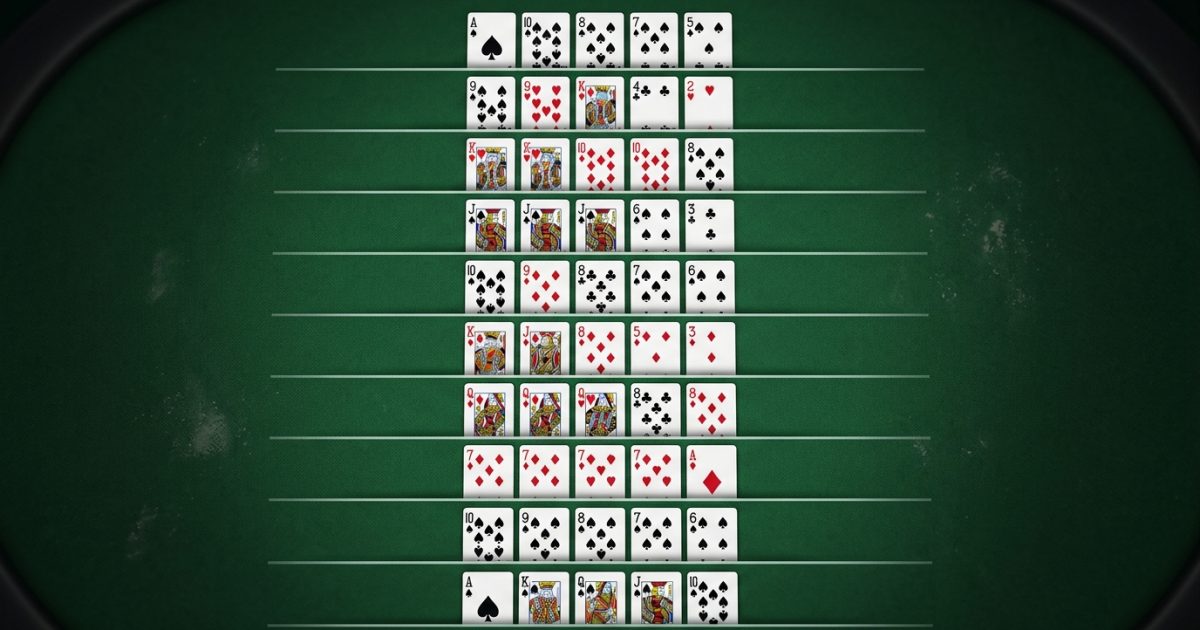
The complete hand rankings, from strongest to weakest:
1. Royal Flush — A, K, Q, J, 10 all of the same suit. The best possible hand in poker. Unbeatable.
2. Straight Flush — Five consecutive cards of the same suit. Example: 9, 8, 7, 6, 5 of hearts. Ranked by the highest card in the sequence.
3. Four of a Kind (Quads) — Four cards of the same rank plus one kicker. Example: Four Kings plus a Seven. Higher quads beat lower quads.
4. Full House — Three of a kind plus a pair. Example: Three Aces and two Eights (“Aces full of Eights”). The three-of-a-kind portion determines ranking first.
5. Flush — Five cards of the same suit, not in sequence. Example: A, J, 8, 5, 3 of clubs. Ranked by the highest card, then second-highest, and so on.
6. Straight — Five consecutive cards of mixed suits. Example: 10, 9, 8, 7, 6. The Ace can be high (A-K-Q-J-10) or low (5-4-3-2-A, known as the “wheel”).
7. Three of a Kind (Trips or Set) — Three cards of the same rank plus two unrelated cards. Example: Three Jacks. A “set” is when you hold a pair and one appears on the board; “trips” is when two are on the board and one in your hand.
8. Two Pair — Two different pairs plus one kicker. Example: Two Queens and two Fives with a Nine kicker. Ranked by the higher pair first, then the lower pair, then the kicker.
9. One Pair — A single pair plus three unrelated cards. Example: Two Tens with A, 8, 4 kickers. Ranked by the pair first, then kickers in descending order.
10. High Card — No made hand. Ranked by the highest card, then subsequent cards. Example: A, J, 8, 5, 3 of mixed suits (“Ace high”).
Example
The board reads King of spades, Ten of hearts, Ten of clubs, Seven of diamonds, Three of spades. Three players reach showdown:
- Player A holds Ace-King. Their best hand is two pair: Kings and Tens, with an Ace kicker (K-K-10-10-A using one board Ten and the board King paired with their King).
Wait — more precisely: Player A has King (hole) pairing the board King, plus the pair of Tens on the board = two pair, Kings and Tens, Ace kicker.
- Player B holds Ten-Seven. Their best hand is a full house: Tens full of Sevens (three Tens using their hole Ten plus two board Tens, and a pair of Sevens using their hole Seven plus the board Seven).
- Player C holds Ace-Queen. Their best hand is a pair of Tens (from the board) with A, K, Q kickers.
Player B wins with the full house, which ranks higher than Player A’s two pair. Player A’s two pair beats Player C’s single pair. The rankings determine everything.
Common Mistakes
- Confusing full house ranking order. In a full house, the three-of-a-kind portion ranks first. Threes full of Aces (3-3-3-A-A) loses to Fours full of Twos (4-4-4-2-2). The pair portion only matters when two players have the same three-of-a-kind rank.
- Forgetting that only five cards matter. In Hold’em, you form the best five-card hand from seven available cards (two hole cards plus five community cards). A sixth or seventh card is never considered. Two players with the same best five-card hand split the pot regardless of their other cards.
- Overvaluing low-ranked hands. New players often get excited about making any pair or two pair without recognizing how vulnerable these hands can be on certain board textures. Consult our strategy guides to learn when strong-looking hands are actually in danger.
Related Terms
- Royal Flush — the highest-ranking hand in poker
- Straight Flush — the second-highest hand ranking
- Full House — the fourth-highest hand ranking
- Flush — the fifth-highest hand ranking
- Showdown — where hand rankings determine the winner
FAQ
Do hand rankings change between different poker games?
In standard (high) poker games like Hold’em, Omaha, and Stud, the rankings are always the same. However, lowball games like Razz use inverted rankings where the lowest hand wins. Omaha Hi-Lo and Stud Hi-Lo split the pot between the best high hand and the best qualifying low hand. Always verify which ranking system your game uses.
What happens when two players have the same hand ranking?
Ties are broken by comparing the relevant cards within the ranking. For flushes, compare the highest card, then second-highest, and so on. For pairs, compare the pair rank first, then kickers. If all five cards are identical in value (regardless of suit), the pot is split. Suits never determine a winner in standard poker.
How rare are the top hand rankings?
In Texas Hold’em, the probability of making a royal flush by the river is approximately 1 in 30,940. A straight flush (excluding royal) occurs about 1 in 3,590. Four of a kind hits roughly 1 in 595. A full house appears about 1 in 37.5 hands, and a flush about 1 in 32.1 hands. Use our poker odds calculator to explore probabilities for specific situations.