Multi-Table Tournament (MTT)
Quick Definition
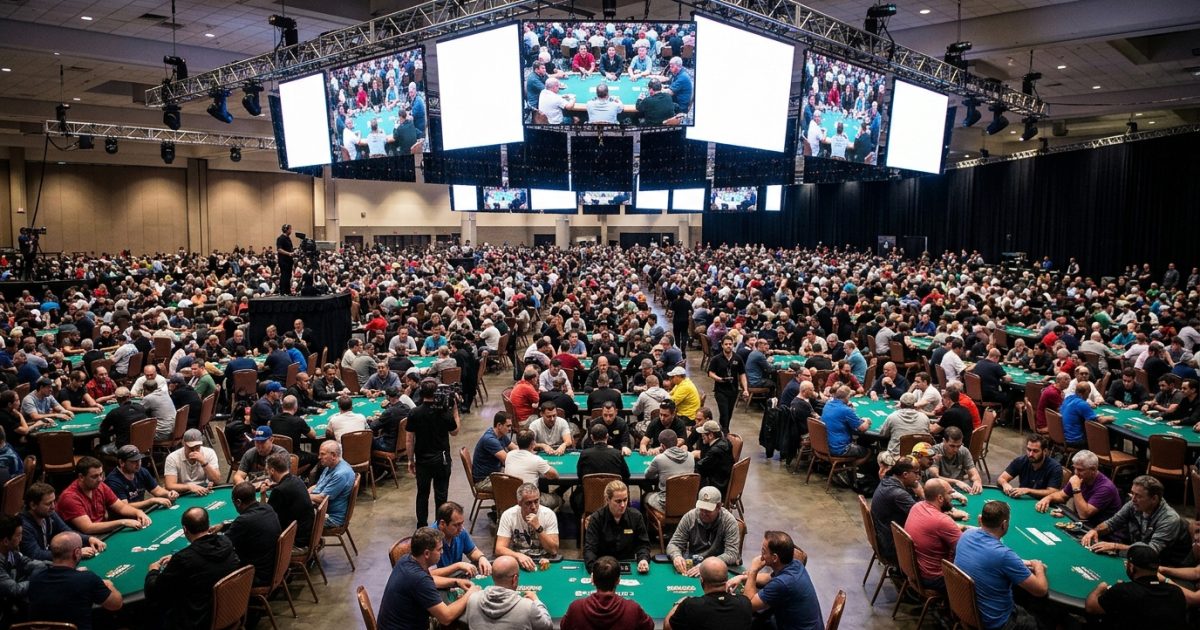
A multi-table tournament (MTT) is a poker tournament with a scheduled start time where hundreds or thousands of players compete across multiple tables, with blinds increasing at set intervals until one player holds all the chips.
What Is a Multi-Table Tournament?
Multi-table tournaments are the format that made poker famous. From the World Series of Poker Main Event to the PokerStars Sunday Million, MTTs offer the dream of turning a small buy-in into a life-changing score. Every player starts with the same number of chips, the blinds escalate on a fixed schedule, and players are eliminated until a single winner remains.
The appeal of MTTs lies in their massive payout potential. A $100 buy-in Sunday major might attract 5,000 players, creating a $500,000 prize pool where first place takes home $75,000 or more. This top-heavy payout structure creates the enormous upside that draws players to the format — and the variance that keeps them humble.
MTTs require a unique combination of skills that evolves throughout the tournament. Early stages demand patient, deep-stacked play. Middle stages require chip accumulation and aggression. Late stages shift to survival and ICM-aware decision-making. The final table is its own battlefield, where every position change means a significant jump in prize money. Mastering all these phases is what separates the occasional winner from the consistent MTT professional.
How It Works
Registration: Players register before or during the tournament. Most MTTs offer late registration for a set period (typically 60 to 120 minutes) after the tournament begins.
Starting Stacks and Blinds: All players receive identical starting stacks. Blinds increase at regular intervals — every 10 to 15 minutes in standard events, every 5 to 8 minutes in turbos. As blinds rise, short-stacked players face increasing pressure to act.
Table Balancing: As players are eliminated, tables are broken and remaining players are redistributed to maintain balanced table sizes across the field.
Payout Structure: Typically the top 10% to 15% of the field receives a payout. The structure is heavily weighted toward the top positions, with first place receiving 15% to 20% of the total prize pool. Min-cashes at the bottom of the payout ladder return approximately 1.5 to 2 times the buy-in.
Final Table: When the field is reduced to the last table (usually 9 players in Hold’em, 6 in some formats), the final table begins. This is where the largest pay jumps occur and where ICM pressure is most intense.
Example
You enter a $55 buy-in MTT with a $200,000 guarantee. The tournament attracts 4,500 players, creating a $225,000 prize pool that exceeds the guarantee. You start with 15,000 chips at 25/50 blinds. Through five hours of play, you navigate the early stages, survive the bubble at 675 players, and build a competitive stack. With 50 players remaining, you are above average. You reach the final table with 9 players left, where minimum payout is $5,500 and first place is $38,000. After intense short-handed play, you finish third for $18,000 — a 327x return on your $55 investment.
Where to Find the Best MTTs
The quality of an MTT schedule depends on prize pool guarantees, field sizes, blind structures, and the variety of buy-in levels offered.
- GGPoker hosts some of the largest online MTT series globally, including the WSOP Online and their own GG Series, with guarantees reaching into the millions.
- PokerStars remains the gold standard for MTTs with the Sunday Million, WCOOP, SCOOP, and the deepest tournament schedule in online poker.
- 888poker offers the popular XL Series and regular Sunday majors with strong guarantees relative to buy-ins.
- PartyPoker features the MILLIONS Online series with some of the largest buy-ins and prize pools in the industry.
Related Terms
- Sit & Go — a smaller tournament format that starts when seats are filled rather than at a scheduled time
- ICM — the chip valuation model essential for MTT decision-making near the money
- Bubble — the critical phase just before payouts begin
- Final Table — the last table of an MTT where the biggest prizes are awarded
- Satellite — tournaments that award entries into larger MTTs
FAQ
How long do multi-table tournaments last?
Duration depends on the field size and blind structure. A standard-speed MTT with 1,000 players typically takes 6 to 8 hours to reach a winner. Large-field events with 5,000 or more players can last 10 to 14 hours. Turbo and hyper-turbo formats are significantly faster.
What is a good ROI for MTT players?
A consistent ROI of 20% to 50% is considered strong for mid-stakes MTT grinders. Elite players can sustain 50% to 100% ROI, but sample sizes must be large — at least 1,000 tournaments — to draw meaningful conclusions due to the high variance of the format.
Should I play MTTs or cash games?
MTTs offer higher upside per session but come with significant variance. You might lose for weeks before landing a big score. Cash games provide steadier, more predictable income. Many players combine both formats, using cash game income to fund MTT buy-ins for the shot at a big payday.