Position
Quick Definition
Position refers to where you sit relative to the dealer button, which determines when you act during each betting round -- acting later gives you a significant strategic advantage.
What Is Position?
Position is the single most important strategic concept in poker. It determines the order in which you act during every betting round, and acting later means having more information before you make your decision. When you see what your opponents do before you act, you gain a massive edge in hand reading, pot control, and bluffing opportunities.
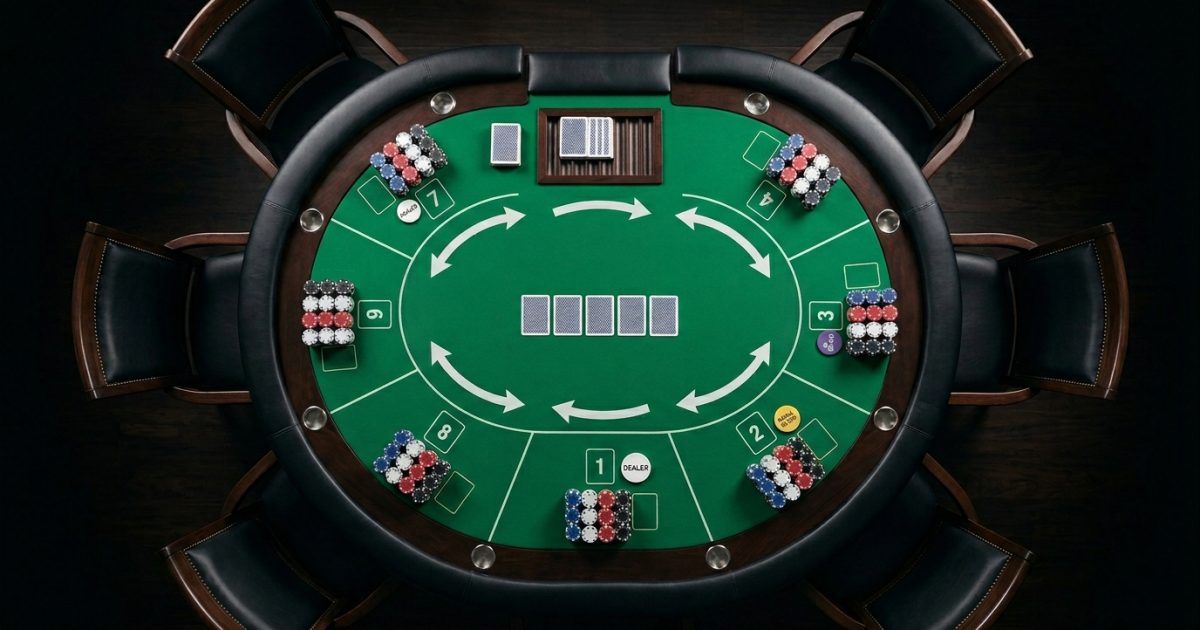
Every seat at a poker table is categorized into positional zones. In a standard nine-handed game, positions are divided into early position (first to act), middle position, and late position (last to act). The player on the button has the best position at the table because they act last on every post-flop street — the flop, turn, and river.
The impact of position on win rates is dramatic and well-documented. Data from millions of online hands shows that players are substantially more profitable from late position than from early position, even holding the same cards. This is not a minor edge. Position transforms marginal hands into playable ones and turns strong hands into monsters. Understanding and exploiting positional advantage is what separates winning players from losing ones.
How It Works
At a nine-handed table, positions are assigned as follows (moving clockwise from the button):
Late Position (LP):
- Button (BTN): The best seat. Acts last on all post-flop streets. Can play the widest range of hands.
- Cutoff (CO): One seat right of the button. The second-best position, with nearly all the advantages of the button.
Middle Position (MP):
- Hijack (HJ): Two seats right of the button. A transitional seat where you can begin to widen your range.
- MP (Lojack): Three seats right of the button. Still requires a fairly tight range but offers some positional advantage over early positions.
Early Position (EP):
- UTG (Under the Gun): First to act preflop. The worst position, requiring the strongest starting hands.
- UTG+1 and UTG+2: Slightly better than UTG but still early position with many players yet to act.
Blinds:
- Small Blind (SB): Posts a forced half-bet and acts second-to-last preflop but first post-flop. A losing position by nature.
- Big Blind (BB): Posts a forced full bet and acts last preflop but second post-flop. Defends at a discount but is out of position for all later streets.
The key principle: wider hand ranges from later positions, tighter ranges from earlier positions. From the button, you might open-raise with 40-50% of hands. From UTG, that narrows to perhaps 12-15%.
Example
You are dealt Jack-Ten suited in two different scenarios:
Scenario 1: Under the Gun. You are first to act with seven players still behind you. Jack-Ten suited is a speculative hand that plays poorly out of position against multiple opponents. Most winning players fold this hand from UTG because the risk of being called and then playing the rest of the hand out of position outweighs the potential reward.
Scenario 2: The Button. Everyone folds to you. Now Jack-Ten suited is a strong open-raise. You only have two players behind you (the blinds), and if either calls, you will act last on every subsequent street. You can control the pot size with checks, extract value with bets when you connect, and bluff effectively when the board favors your perceived range.
Same hand, completely different play — all because of position.
Common Mistakes
- Playing the same range from every position. Your starting hand requirements should tighten dramatically as you move to earlier positions. A hand that is a clear raise from the button can be a clear fold from UTG. Ignoring this adjustment is one of the fastest ways to lose money.
- Undervaluing the cutoff and button. Many players focus on their cards without considering the immense advantage of late position. Playing too tight from the cutoff and button leaves significant profit unclaimed. These are your most profitable seats — use them aggressively.
- Calling from the small blind too often. The small blind is the worst position at the table. You have a partial investment in the pot, which tempts you to “complete” or call raises, but you will be out of position for every future street. Be selective with your small blind defenses. Check our guides section for detailed positional opening ranges.
Related Terms
- Button — the most advantageous position at the table
- Blinds — forced bets posted from the two worst positional seats
- Preflop — the betting round where positional awareness begins
- Flop — the first post-flop street where positional advantage is fully realized
- All-In — position is irrelevant once all chips are in the middle
FAQ
How much does position really affect win rates?
Significantly. Analysis of large hand databases consistently shows that the button is the most profitable seat, earning roughly 2-3 times more per hand than middle position seats. The blinds are consistent money-losers over time, even for elite players. The difference is so pronounced that many coaches consider positional play the first concept a new player should master.
What does “in position” versus “out of position” mean?
Being “in position” means you act after your opponent on each betting round. Being “out of position” means you act first. In position, you get to see what your opponent does before deciding. Out of position, you must act without that information. This asymmetry affects every aspect of strategy, from hand selection to bet sizing to bluff frequency.
Does position matter in tournaments the same as cash games?
Yes, position is equally important in both formats. However, tournament dynamics like stack sizes relative to blinds and antes, ICM pressure, and table dynamics add layers of complexity. Short-stacked tournament play may force all-in decisions that negate positional advantages, but when stacks are deep enough for multi-street play, position remains the dominant strategic factor. Our poker room reviews cover the best sites for both cash games and tournaments.